Interactive Maths - The Interactive Way to Teach Mathematics
  • Interactive Maths
    • Activities Index
    • 50 Great Activities for Any Classroom
    • QQI Activity Descriptions
    • About Me
    • Contact Me
    • Links
    • Legal & Fees
    • Privacy Policy
  • Blog
  • Topic Resources
    • Number >
      • Arithmetic >
        • The Four Operations >
          • The Four Operations (QQI)
          • The Four Operations (10QQI)
          • The Four Operations (QQI Count Down)
          • The Four Operations (QQI Relay)
          • The Four Operations (QQI BINGO)
          • The Four Operations (QQI Worksheets)
          • The Four Operations (Video)
          • Timestables Square (QQI)
          • Grid Multiplication (QQI)
        • Missing Numbers >
          • Missing Numbers (QQI)
          • Missing Numbers (10QQI)
          • Missing Numbers (QQI Count Down)
          • Missing Numbers (QQI Relay)
          • Missing Numbers (QQI BINGO)
          • Missing Numbers (QQI Worksheets)
        • Order of Operations >
          • Order of Operations (QQI)
          • Order of Operations (10QQI)
          • Order of Operations (QQI Count Down)
          • Order of Operations (QQI Relay)
          • Order of Operations (QQI BINGO)
          • Order of Operations (QQI Worksheets)
        • Powers of Ten >
          • Powers of Ten (QQI)
          • Powers of Ten (10QQI)
          • Powers of Ten (QQI Count Down)
          • Powers of Ten (QQI Relay)
          • Powers of Ten (QQI BINGO)
          • Powers of Ten (QQI Worksheets)
        • Decimal Operations >
          • Decimal Operations (QQI)
          • Decimal Operations (10QQI)
          • Decimal Operations (QQI Count Down)
          • Decimal Operations (QQI Relay)
          • Decimal Operations (QQI BINGO)
          • Decimal Operations (QQI Worksheets)
        • Rounding >
          • Rounding (QQI)
          • Rounding (10QQI)
          • Rounding (QQI Count Down)
          • Rounding (QQI Relay)
          • Rounding (QQI BINGO)
          • Rounding (QQI Worksheets)
        • Products and Sums (QQI)
        • Products and Sums (10QQI)
      • Fractions >
        • Cancelling Fractions >
          • Cancelling Fractions (QQI)
          • Cancelling Fractions (10QQI)
          • Cancelling Fractions (QQI Count Down)
          • Cancelling Fractions (QQI Relay)
          • Cancelling Fractions (QQI BINGO)
          • Cancelling Fractions (QQI Worksheets)
        • Mixed Numbers and Improper Fractions >
          • Mixed Numbers and Improper Fractions (QQI)
          • Mixed Numbers and Improper Fractions (10QQI)
          • Mixed Numbers and Improper Fractions (QQI Count Down)
          • Mixed Numbers and Improper Fractions (QQI Relay)
          • Mixed Numbers and Improper Fractions (QQI BINGO)
          • Mixed Numbers and Improper Fractions (QQI Worksheets)
        • Fractions of Amounts >
          • Fractions of Amounts (QQI)
          • Fractions of Amounts (10QQI)
          • Fractions of Amounts (QQI Count Down)
          • Fractions of Amounts (QQI Relay)
          • Fractions of Amounts (QQI BINGO)
          • Fractions of Amounts (QQI Worksheets)
        • Fraction Arithmetic >
          • Fraction Arithmetic (QQI)
          • Fraction Arithmetic (10QQI)
          • Fraction Arithmetic (QQI Count Down)
          • Fraction Arithmetic (QQI Relay)
          • Fraction Arithmetic (QQI BINGO)
          • Fraction Arithmetic (QQI Worksheets)
      • FDP >
        • Fraction Decimal Conversions Drill
      • Percentages >
        • Percentages of Amounts >
          • Percentages of Amounts (QQI)
          • Percentages of Amounts (10QQI)
          • Percentages of Amounts (QQI Count Down)
          • Percentages of Amounts (QQI Relay)
          • Percentages of Amounts (QQI BINGO)
          • Percentages of Amounts (QQI Worksheets)
          • Percentage of Amounts (Video)
        • Writing Numbers as a Percentage >
          • Writing Numbers as a Percentage (QQI)
          • Writing Numbers as a Percentage (10QQI)
          • Writing Numbers as a Percentage (QQI Count Down)
          • Writing Numbers as a Percentage (QQI Relay)
          • Writing Numbers as a Percentage (QQI BINGO)
          • Writing Numbers as a Percentage (QQI Worksheets)
          • Writing Numbers as a Percentage (Video)
        • Percentage Change >
          • Percentage Change (QQI)
          • Percentage Change (10QQI)
          • Percentage Change (QQI Count Down)
          • Percentage Change (QQI Relay)
          • Percentage Change (QQI Worksheets)
          • Percentage Change (Video)
        • Increase and Decrease by a Percentage >
          • Increase and Decrease by a Percentage (QQI)
          • Increase and Decrease by a Percentage (10QQI)
          • Increase and Decrease by a Percentage (QQI Count Down)
          • Increase and Decrease by a Percentage (QQI Relay)
          • Increase and Decrease by a Percentage (QQI BINGO)
          • Increase and Decrease by a Percentage (QQI Worksheets)
          • Increase and Decrease by a Percentage (Video)
        • Compound Interest and Simple Interest >
          • Compound Interest and Simple Interest (QQI)
          • Compound Interest and Simple Interest (10QQI)
          • Compound Interest and Simple Interest (QQI Count Down)
          • Compound Interest and Simple Interest (QQI Relay)
          • Compound Interest and Simple Interest (QQI BINGO)
          • Compound Interest and Simple Interest (QQI Worksheets)
          • Compound Interest and Simple Interest (Video)
        • Overall Percentage Change >
          • Overall Percentage Change (QQI)
          • Overall Percentage Change (10QQI)
          • Overall Percentage Change (QQI Count Down)
          • Overall Percentage Change (QQI Relay)
          • Overall Percentage Change (QQI BINGO)
          • Overall Percentage Change (QQI Worksheets)
        • Reverse Percentages >
          • Reverse Percentages (QQI)
          • Reverse Percentages (10QQI)
          • Reverse Percentages (QQI Count Down)
          • Reverse Percentages (QQI Relay)
          • Reverse Percentages (QQI BINGO)
          • Reverse Percentages (QQI Worksheets)
          • Reverse Percentages (Video)
        • Mixed Percentages >
          • Mixed Percentages (QQI)
          • Mixed Percentages (10QQI)
          • Mixed Percentages (QQI Count Down)
          • Mixed Percentages (QQI Relay)
          • Mixed Percentages (QQI BINGO)
          • Mixed Percentages (QQI Worksheets)
      • Factors and Multiples >
        • Number Properties (QQI)
        • Product of Primes >
          • Product of Primes (QQI)
          • Product of Primes (10QQI)
          • Product of Primes (QQI Count Down)
          • Product of Primes (QQI Relay)
          • Product of Primes (QQI BINGO)
          • Product of Primes (QQI Worksheets)
        • HCF and LCM >
          • HCF and LCM (QQI)
          • HCF and LCM (10QQI)
          • HCF and LCM (QQI Count Down)
          • HCF and LCM (QQI Relay)
          • HCF and LCM (QQI BINGO)
          • HCF and LCM (QQI Worksheets)
          • HCF and LCM (Video)
        • 100 Square Multiples (QQI)
        • 100 Square Types of Numbers (QQI)
      • Standard Form >
        • Standard Form Conversions >
          • Standard Form Conversions (QQI)
          • Standard Form Conversions (10QQI)
          • Standard Form Conversions (QQI Count Down)
          • Standard Form Conversions (QQI Relay)
          • Standard Form Conversions (QQI BINGO)
          • Standard Form Conversions 2 (QQI BINGO)
          • Standard Form Conversions (QQI Worksheets)
        • Standard Form Arithmetic >
          • Standard Form Arithmetic (QQI)
          • Standard Form Arithmetic (10QQI)
          • Standard Form Arithmetic (QQI Count Down)
          • Standard Form Arithmetic (QQI Relay)
          • Standard Form Arithmetic (QQI BINGO)
          • Standard Form Arithmetic (QQI Worksheets)
      • Ratio and Proportion >
        • Ratio (Video)
      • Surds >
        • Surds Activities >
          • Surds (QQI)
          • Surds (10QQI)
          • Surds (QQI Count Down)
          • Surds (QQI Relay)
          • Surds (QQI BINGO)
          • Surds (QQI Worksheets)
    • Algebra >
      • Algebraic Manipulation >
        • Collecting Like Terms >
          • Collecting Like Terms (QQI)
          • Collecting Like Terms (10QQI)
          • Collecting Like Terms (QQI Count Down)
          • Collecting Like Terms (QQI Relay)
          • Collecting Like Terms (QQI BINGO)
          • Collecting Like Terms (QQI Worksheets)
        • Expanding Single Brackets >
          • Expanding Single Brackets (QQI)
          • Expanding Single Brackets (10QQI)
          • Expanding Single Brackets (QQI Count Down)
          • Expanding Single Brackets (QQI Relay)
          • Expanding Single Brackets (QQI BINGO)
          • Expanding Single Brackets (QQI Worksheets)
        • Factorising >
          • Factorising (QQI)
          • Factorising (10QQI)
          • Factorising (QQI Count Down)
          • Factorising (QQI Relay)
          • Factorising (QQI BINGO)
          • Factorising (QQI Worksheets)
        • Expanding Quadratic Brackets >
          • Expanding Quadratic Brackets (QQI)
          • Expanding Quadratic Brackets (10QQI)
          • Expanding Quadratic Brackets (QQI Count Down)
          • Expanding Quadratic Brackets (QQI Relay)
          • Expanding Quadratic Brackets (QQI BINGO)
          • Expanding Quadratic Brackets (QQI Worksheets)
        • Factorising Quadratics >
          • Factorising Quadratics (QQI)
          • Factorising Quadratics (10QQI)
          • Factorising Quadratics (QQI Count Down)
          • Factorising Quadratics (QQI Relay)
          • Factorising Quadratics (QQI BINGO)
          • Factorising Quadratics (QQI Worksheets)
          • Factorising Quadratic Expressions (Video)
          • Factorising Four Term Expressions (Video)
        • Indices >
          • Indices (QQI)
          • Indices (10QQI)
          • Indices (QQI Count Down)
          • Indices (QQI Relay)
          • Indices (QQI BINGO)
          • Indices (QQI Worksheets)
        • Completing the Square >
          • Completing the Square (QQI)
          • Completing the Square (10QQI)
          • Completing the Square (QQI Count Down)
          • Completing the Square (QQI Relay)
          • Completing the Square (QQI BINGO)
          • Completing the Square 2 (QQI BINGO)
          • Completing the Square (QQI Worksheets)
        • Algebraic Fractions >
          • Simplifying Algebraic Fractions (Video)
          • Adding and Subtracting Algebraic Fractions (Video)
          • Multiplying and Dividing Algebraic Fractions (Video)
      • Coordinates >
        • Coordinates (GGB)
        • Coordinate Battleship First Quadrant (GGB)
        • Coordinate Battleship All Four Quadrants (GGB)
        • 3D Coordinates (AGG)
      • Equations >
        • Linear Equations >
          • Solving Linear Equations >
            • Solving Linear Equations (QQI)
            • Solving Linear Equations (10QQI)
            • Solving Linear Equations (QQI Count Down)
            • Solving Linear Equations (QQI Relay)
            • Solving Linear Equations (QQI BINGO)
            • Solving Linear Equations (QQI Worksheets)
          • Solving Equations with Algebraic Fractions (Video)
        • Quadratic Equations >
          • Solving Quadratic Equations >
            • Solving Quadratics Factorising Tool
            • Solving Quadratic Equations (QQI)
            • Solving Quadratic Equations (10QQI)
            • Solving Quadratic Equations (QQI Count Down)
            • Solving Quadratic Equations (QQI Relay)
            • Solving Quadratic Equations (QQI BINGO)
            • Solving Quadratic Equations (QQI Worksheets)
          • Solving Quadratic Equations by Factorising (Video)
          • The Quadratic Formula (Video)
          • Problems Involving Quadratic Equations (Video)
        • Simultaneous Equations >
          • Solving Simultaneous Equations >
            • Solving Simultaneous Equations (QQI)
            • Solving Simultaneous Equations (10QQI)
            • Solving Simultaneous Equations (QQI Count Down)
            • Solving Simultaneous Equations (QQI Relay)
            • Solving Simultaneous Equations (QQI Relay Fixed)
            • Solving Simultaneous Equations (QQI BINGO)
            • Solving Simultaneous Equations (QQI Worksheets)
          • Solving Simultaneous Equations Graphically (Video)
          • Simultaneous Equations by Substitution (Video)
          • Simultaneous Equations by Elimination (Video)
          • Simultaneous Equations - One Non-Linear (Video)
      • Sequences >
        • Sequences Activity (QQI)
        • Sequences Activities >
          • Sequences (QQI)
          • Sequences (10QQI)
          • Sequences (QQI Count Down)
          • Sequences (QQI Relay)
          • Sequences (QQI BINGO)
          • Sequences (QQI Worksheets)
        • Generating Sequences (Video)
        • General Term for Linear Sequences (Video)
        • Simple Quadratic Sequences (Video)
        • General Term for Quadratic Sequences (Video)
        • General Term for Cubic Sequences (Video)
        • Geometric Sequences (Video)
        • Common Differences (QQI)
      • Graphs >
        • Straight Line Graphs >
          • Drawing Straight Line Graphs (GGB)
          • Gradient of a Line (GGB)
          • Gradient of a Line 2 (GGB)
          • Parallel Lines (GGB)
          • Perpendicular Lines (GGB)
          • y = mx + c Activity (GGB)
          • Battleships 1 (AGG)
          • Battleships 2 (AGG)
          • Battleships 3 (AGG)
          • Find the Lines 1 (AGG)
          • Regions in Graphs (Video)
        • Non-Linear Graphs >
          • Drawing Curves (GGB)
          • Quadratic Graphs Activity (GGB)
          • Finding Quadratic Functions (Video)
        • Graphs with a Casio GDC (Video)
      • Graph Transformations >
        • Graph Transformations 1 (GGB)
        • Graph Transformations 2 (GGB)
        • Graph Transformations 3 (GGB)
        • Graph Transformations 4 (GGB)
        • Graph Transformations 5 (GGB)
        • Graph Transformations 6 (GGB)
      • Functions >
        • Functions Introductions (Video)
        • Function Graphs and Important Points (Video)
        • Solving Unfamiliar Equations Using Functions (Video)
        • Function Notation Revision (Video)
        • Composite Functions (Video)
        • Inverse Functions (Video)
    • Shape >
      • Symmetry >
        • Reflection Symmetry >
          • Reflection Symmetry in Quadrilaterals (GGB)
          • Reflection Symmetry in Triangles (GGB)
          • Reflection Symmetry in Other Shapes (GGB)
        • Rotational Symmetry >
          • Rotational Symmetry in Quadrilaterals (GGB)
          • Rotational Symmetry in Triangles (GGB)
          • Rotational Symmetry in Other Shapes (GGB)
      • Area and Perimeter >
        • Polygons >
          • Perimeters (GGB)
          • Area of a Triangle (GGB)
          • Area of a Parallelogram (GGB)
          • Area of a Trapezium (GGB)
          • Area of Compound Shapes (GGB)
          • Perimeter and Area (GGB)
        • Circles >
          • Discovering Pi (GGB)
          • Circumference of a Circle (GGB)
          • Area of a Circle (GGB)
          • Running Tracks (GGB)
          • Circle Area Problem (GGB)
          • Circles and Squares (GGB)
        • Area (QQI)
        • Area (10QQI)
        • Tilted Squares (GGB)
        • Difference Between Two Squares (GGB)
      • Volume and Surface Area >
        • Volumes and Surface Areas (QQI)
        • Volumes and Surface Areas (10QQI)
      • Angles >
        • Guess the Angle (GGB)
        • Angles on a Straight Line (GGB)
        • Angles around a Point (GGB)
        • Angles in a Triangle (GGB)
        • Angles in a Quadrilateral (GGB)
        • Angles in a Regular Polygon (GGB)
        • Angles on Parallel Lines (GGB)
        • Striping Angles (GGB)
      • Transformations >
        • Reflection >
          • Reflections (GGB)
          • Reflection Challenge (GGB)
        • Rotation >
          • Rotations (GGB)
          • Rotation Challenge (GGB)
        • Translation >
          • Translations (GGB)
          • Translation Challenge (GGB)
        • Enlargement >
          • Enlargements (GGB)
          • Enlargement Challenge (GGB)
          • Other Scale Factors (GGB)
        • Challenges >
          • Which Transformation (GGB)
          • How Many Transformations (GGB)
          • Find Them All (AGG)
          • Ultimate Challenge (GGB)
        • Matrix Transformations (AGG)
      • Pythagoras Theorem >
        • Pythagoras Theorem Activities >
          • Pythagoras Theorem (QQI)
          • Pythagoras Theorem (10QQI)
          • Pythagoras Theorem (QQI Count Down)
          • Pythagoras Theorem (QQI Relay)
          • Pythagoras Theorem (QQI BINGO)
          • Pythagoras Theorem (QQI Worksheets)
        • Pythagoras Theorem (GGB)
        • Pythagorean Triples (GGB)
        • Pythagoras Proof (GGB)
        • Ladders up Walls (GGB)
        • Pythagoras in 3D (GGB)
        • Finding the Hypotenuse Example (Video)
        • Finding a Shorter Side Example (Video)
      • Trigonometry >
        • Right Angled Trigonometry >
          • Right Angled Trigonometry (QQI)
          • Right Angled Trigonometry (10QQI)
          • Right Angled Trigonometry (QQI Count Down)
          • Right Angled Trigonometry (QQI Relay)
          • Right Angled Trigonometry (QQI BINGO)
          • Right Angled Trigonometry (QQI Worksheets)
          • Discovering Trig Ratios (GGB)
          • Finding Lengths (GGB)
          • Finding Missing Lengths (Video)
          • Finding Missing Angles (Video)
        • Sine Rule (Video)
        • Cosine Rule (Video)
        • Sine and Cosine Rules (Video)
      • Circle Theorems >
        • Angle in the Centre vs Angle at the Circumference (GGB)
        • Angle at the Centre vs Angle at the Circumference (Video)
        • Angles in a Semicircle (GGB)
        • Angle in a Semicircle (Video)
        • Angles in Cyclic Quadrilaterals (GGB)
        • Angles in a Cyclic Quadrilateral (Video)
        • Angles in the Same Segment (GGB)
        • Angles in the Same Segment (Video)
        • Tangents (GGB)
        • Tangents (Video)
        • Alternate Segment Theorem (GGB)
        • Intersecting Tangents (GGB)
        • Intersecting Tangents (Video)
        • Intersecting Chords (GGB)
      • Vectors >
        • Vectors and Scalars (Video)
        • Vector Notation (Video)
        • Resultant Vectors (Video)
        • Resultants of Column Vectors (Video)
        • Scalar Multiplication (Video)
        • Magnitude of a Vector (Video)
      • Miscellaneous >
        • Squares (GGB)
        • Tangrams (GGB)
        • Euler Line (GGB)
        • Geoboards
    • Statistics >
      • Probability >
        • Probability (QQI)
        • Probability (10QQI)
        • Probability Tools (Flash)
      • Averages >
        • Averages Activity (QQI)
        • Listed Averages >
          • Listed Averages (QQI)
          • Listed Averages (10QQI)
          • Listed Averages (QQI Count Down)
          • Listed Averages (QQI Relay)
          • Listed Averages (QQI BINGO)
          • Listed Averages (QQI Worksheets)
          • Averages From Lists of Data (Video)
          • Quartiles and Interquartile Range (Video)
        • Averages from Frequency Tables >
          • Averages from Frequency Tables (QQI)
          • Averages from Frequency Tables (10QQI)
          • Averages from Frequency Tables (QQI Count Down)
          • Averages from Frequency Tables (QQI Relay)
          • Averages from Frequency Tables (QQI BINGO)
          • Averages from Frequency Tables (QQI Worksheets)
          • Averages From Frequency Tables (Video)
          • Averages From Grouped Frequency Tables (Video)
        • Averages With A GDC (Video)
      • Statistical Diagrams >
        • Cumulative Frequency (Video)
        • Scatter Graphs and the Mean Point (Video)
        • Scatter Graphs and Linear Regression on a GDC (Video)
        • Correlation and the Correlation Coefficient on a GDC (Video)
    • Post 16 Topics >
      • Binomial Expansion >
        • Binomial Expansion (Video)
        • Binomial Theorem (Video)
        • Binomial Coefficients (Video)
        • Binomial Applications (Video)
      • Coordinate Geometry >
        • Coordinate Geometry (QQI)
        • Coordinate Geometry (10QQI)
        • Equation of a Circle (AGG)
      • Differentiation >
        • Differentiating Polynomials >
          • Differentiating Polynomials (QQI)
          • Differentiating Polynomials (10QQI)
          • Differentiating Polynomials (QQI Count Down)
          • Differentiating Polynomials (QQI Relay)
          • Differentiating Polynomials (QQI BINGO)
          • Differentiating Polynomials (QQI Worksheets)
        • Finding Gradients of Curves (QQI)
        • Finding Gradients of Curves (10QQI)
        • Finding Turning Points of Curves (QQI)
        • Finding Turning Points of Curves (10QQI)
      • Trigonometry >
        • Radian and Degree Conversions >
          • Radian and Degree Conversions (QQI)
          • Radian and Degree Conversions (10QQI)
          • Radian and Degree Conversions (QQI Count Down)
          • Radian and Degree Conversions (QQI Relay)
          • Radian and Degree Conversions (QQI BINGO)
          • Radian and Degree Conversions (QQI Worksheets)
        • Trigonometric Exact Values >
          • Trigonometric Exact Values (QQI)
          • Trigonometric Exact Values (10QQI)
          • Trigonometric Exact Values (QQI Count Down)
          • Trigonometric Exact Values (QQI Relay)
          • Trigonometric Exact Values (QQI BINGO)
          • Trigonometric Exact Values (QQI Worksheets)
        • Graphs of Trig Functions (GGB)
      • Normal Distribution Symmetry
  • Starters, Puzzles and Enrichment
    • UKMT Random Question Generator
    • @mathschallenge Random Questions
    • School of Hard Sums Random Questions
    • Random Starter of the Day
    • Mathematically Possible (QQI Starter)
    • Adding Challenge (QQI Starter)
    • Date Starter (QQI Starter)
    • Name That Number (QQI Starter)
    • Matchstick Random Questions
    • Choose 3 Numbers (QQI Starter)
    • What's The Question (QQI Starter)
    • Mathematical Words (QQI Starter)
    • Number of the Day (QQI Starter)
    • Anagrams and Missing Vowels (QQI Starter)
    • Missing Vowels and Word Jumbles (QQI) >
      • Missing Vowels and Word Jumbles Simple Numbers (QQI)
    • Tables (QQI)
    • Target Boards (QQI)
    • Missing Signs (QQI)
    • Random Activities >
      • Exploding Dots
      • Easter Date
      • Easter Tangrams (GGB)
      • Zeller's Algorithm
      • Batman Equation (AGG)
      • Templates
    • Mathematical Videos >
      • Fermat's Last Theorem (Video)
      • Pi Song (Video)
      • Monty Hall Problem (Video)
      • Symmetry, Reality's Riddle (Video)
      • Music of the Primes (Video)
      • Folding Paper (Video)
      • Nature by Numbers (Video)
      • Inspirations (Video)
  • Tools for Teachers
    • IB DP AAHL Online Course
    • Maths Question Generator
    • Topic Question Generator
    • Desmos Annotations
    • MYP eAssessment Investigation Generator
    • IB AI SL Exam Question Generator
    • IB AA HL Key Skills Generator
    • IB DP Exam Grade Boundaries
    • IB MYP Grade Boundaries
    • Exam Timings Tool

Quadratic Functions

24/8/2018

2 Comments

 
In IB Mathematical Studies students have to recognise the Vertex (Completed Square) Form and Root (Factorised) Form of a quadratic function. Although they have a graphical calculator to help them sketch the graphs, they need to know the links in order to find the equation of a given graph. This is utilised in analysing data and creating models that follow a parabola.
In previous years I have taught this through a guided investigation which has students use technology to discover what happens in each of these situations:
  1. y = ax² - what happens as a changes
  2. y = x² + c - what happens as c changes
  3. y = (x + p)² - what happens as p changes
  4. y = (x + p)² + q - what can we say about this function
  5. y = (x + m)(x + n) - what can we say about this function
The actual investigation is more structured than this, with more explicit instructions as to what to focus attention on. I have found in previous years that many students are unable to make the link between the vertex form and the vertex of the parabola. This works well with students in the more advanced courses, but for those in the Mathematical Studies course, it is quite a challenge to discover this themselves.
​This year I decided to try something a little different, following one of the ideas from the amazing variationtheory.com, the activity type that Craig Barton calls Demonstration (https://variationtheory.com/demonstration/). 
​Making use of the new whiteboards I have around my room, I had pairs of students make a prediction of what each graph would look like, before revealing the correct answer. Prior to this lesson we had covered sketching parabolas from the graphical calculator, labelling the important points, so I emphasized that students must label these is possible for each graph they sketched.
​After each "batch" of types of graphs, students returned to their seats, and I projected some example graphs for them to sketch in their notes, and some questions for them to answer. One such of these slides is shown below.
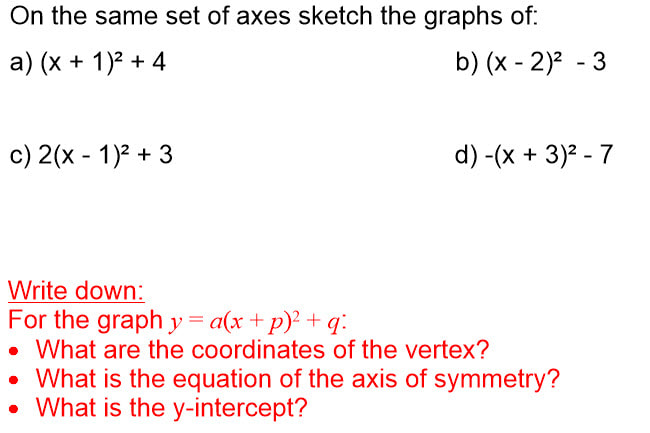
Picture
Those students in the group with a stronger prior knowledge of quadratics definitely took more from this lesson, however, there was still lots of confusion amongst the class. Many struggled to predict the y-intercept. Others got hung up on the idea of translations, which whilst being correct was in this instance getting in the way of them identifying the important points. 
My guess is this was creating a large cognitive load as they were having to turn an equation into a translation (and sometimes stretch) and then draw this sketch. 
​At the end of the lesson I felt frustrated. Although to an observer this may have seemed like a good lesson (students were engaged and working for most of the lesson, they were being relatively successful, and it was clearly challenging them), I knew that they had not learned much from the experience. We did not get to look at graphs in Root Form as there was so much confusion around the prior examples, and some in the class could not even perform at the end of the lesson by stating an equation of a given graph.
​I decided that I needed to reteach this in a different way.
I decided to go along another path set out by Craig Barton, the Pattern Spot (https://variationtheory.com/pattern/).
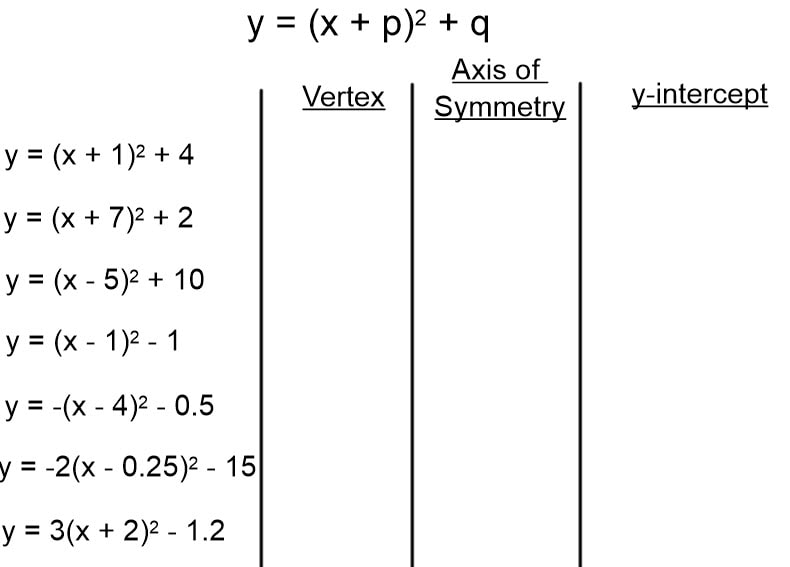
​In the following lesson I just showed a blank set of equations in Vertex Form, with three columns next to them, as shown below.
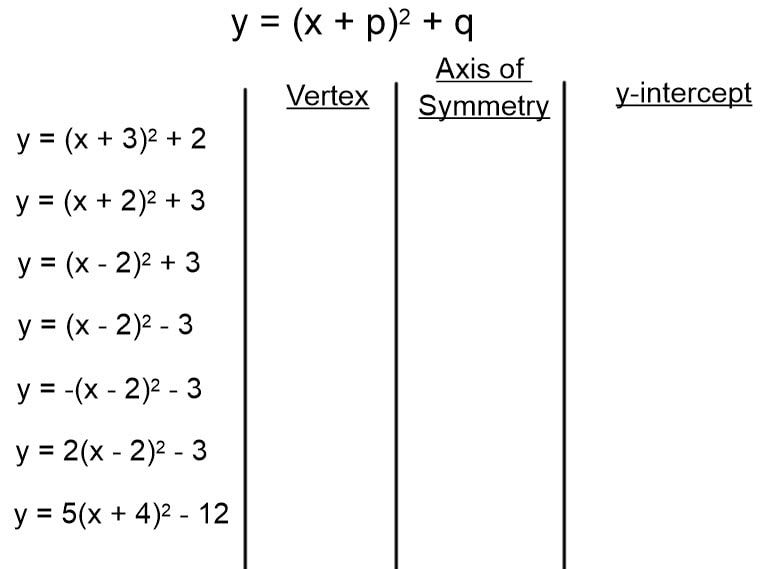
Picture
​Instructing the students to just watch in silence, I proceeded to fill in each row, pausing slightly between each entry. You can see the final filled in slide below.
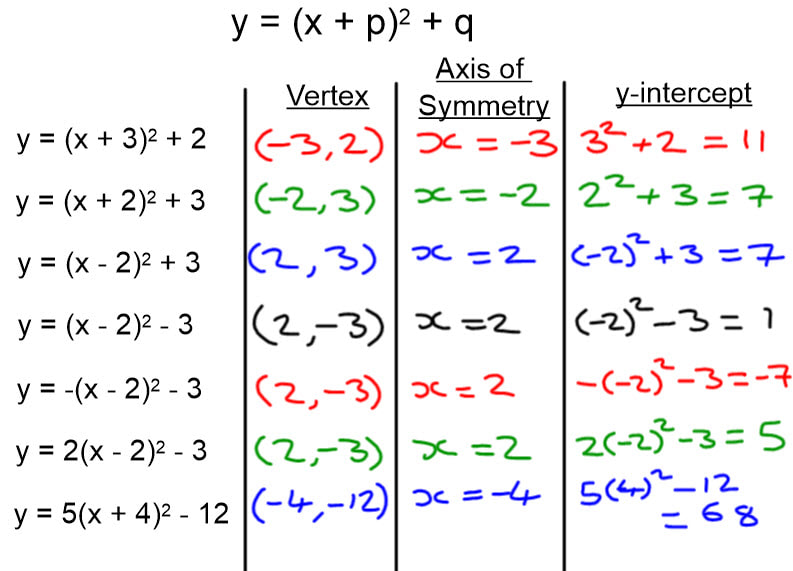
Picture
I then revealed the following set of equations, which I showed side by side with the examples, making use of the dual page display option in SMART Notebook.
Picture
​For those that finished, I challenged them to try to sketch the graphs of the quadratic functions, making use of the information they had just found. 
​During the process, one student asked what the axis of symmetry was. I decided not to tell them at that stage (not wanting to overload their working memory), and told her that I would explain that once they had completed the questions as I wanted them to focus on how to find it first. She was happy with this answer, and was then the first to complete the questions. The same student then said to me that this was much easier to understand than the graphs we had done previously. I asked if she was now able to make connections between this and the sketching we had previously done, to which she responded yes. I know student self-report can be misleading, but I thought it was an interesting comment in the moment. 
​After all students had completed the questions, I took the book of one student and projected their answers using my visualiser, and asked if anybody disagreed with any of the answers shown. There was one disagreement, which I clarified on the board.
​I then used the whiteboard beside my SMARTboard to sketch one of the graphs, and show students what the axis of symmetry was, and straight away one student noted that it went through the vertex and that was why the value matched the x coordinate of the vertex. How before why definitely seemed to help (at least that) student develop a better understanding.
​Then we formalised what we had found in written notes, as shown below.
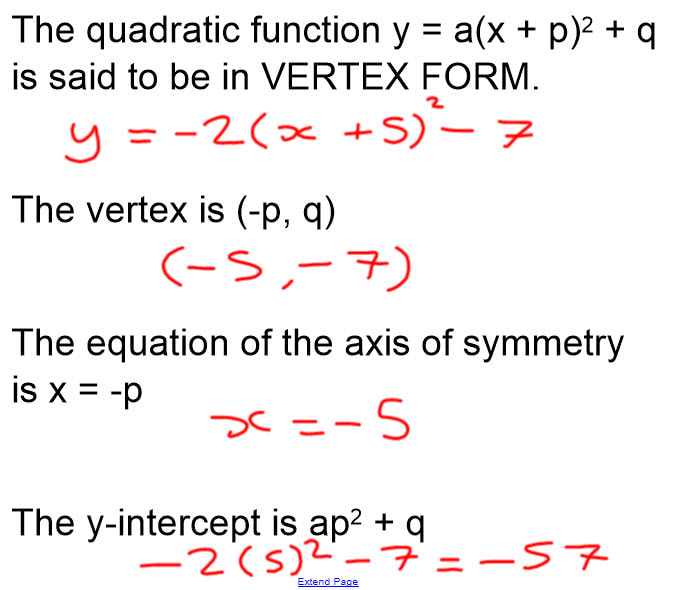
Picture
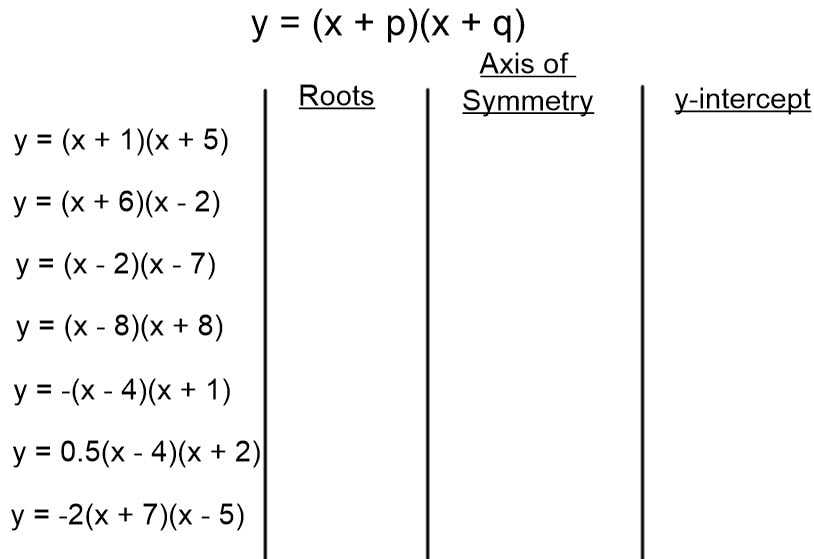
​We then repeated the whole process with the Root Form of a quadratic, with the examples I did and the questions they then did shown below.
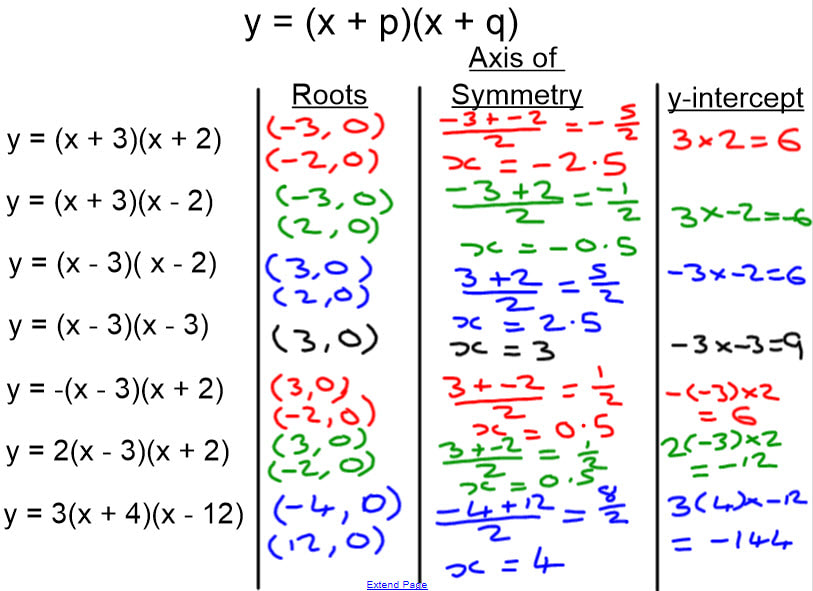
Picture
Picture
​Originally I had included the vertex in these slides, but decided to remove it to lower the intrinsic cognitive load of the task. As students completed the set of questions, this time I challenged them to find the vertex, using what we had discussed about it a few minutes before.
​When they had finished I sketched two parabolas and showed the axis of symmetry. With some encouragement, a student pointed out that it is half way between the roots, and then I linked this to the midpoint formula which they are given in their formulae booklets. We also discussed how we could find the vertex once we knew the axis of symmetry, as the x coordinate is the same (as we had previously discussed), and then use the equation to find the y coordinate (though we will be returning this in more depth soon).
​Again we formalised the discussion in their notes with the following slide.
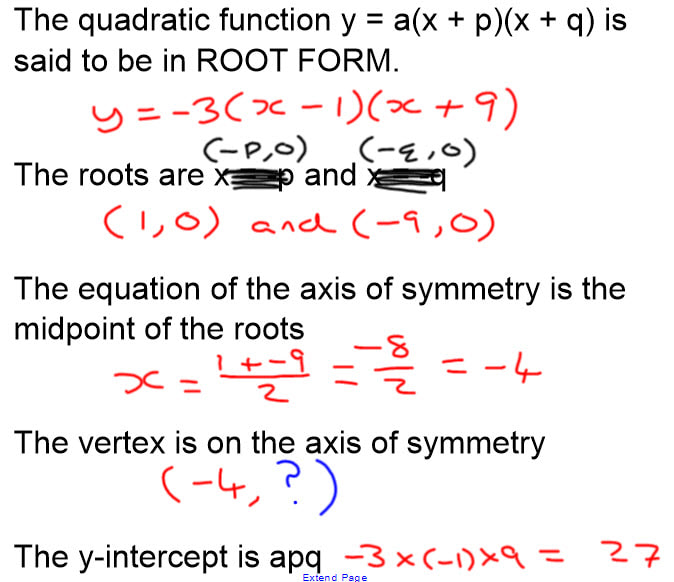
Picture
As the bell drew closer, I sketched a few graphs on the board and Cold Called students to say what the equation would be. In future we will be looking at extending this to include finding the value of the coefficient of x² for a given graph, and then making use of this Geogebra applet (http://www.interactive-maths.com/quadratic-graphs-activity-ggb.html) I made a couple of years ago for this very reason.
​Overall, I felt the second approach worked really well. All students, even those who are currently failing the course, were able to be successful in this topic, which is one of the most difficult on the syllabus. In future, I think I would still do both of these activities, but in the opposite order, only getting students to sketch the graphs after being successful at finding the points. I think this will lower the intrinsic load of the activity, as they can master finding the points first, and then put this into practice when sketching graphs. 
2 Comments
Luke Pearce link
25/8/2018 01:35:52 am

Hi Dan,

I can well imagine that pupils could quickly learn how to find the vertex and line of symmetry by copying your approach.
You then say how you discussed the "why" with them regarding why the line of symmetry has the same number involved as the x-coordinate of the vertex.

What concerns me is that you didn't mention teaching why the vertex is (-p, q) in either of your approaches. Perhaps you did this but just didn't write about it? For me, that is really important and the reason why your students weren't learning well with the first approach.

If they can link their understanding of square numbers always being positive to this situation, it will be much easier for them to store this idea in long term memory as it won't be a brand new, isolated idea.

Luke

Reply
Dan Rodriguez-Clark
25/8/2018 03:49:37 pm

Hi Luke

Really interesting comment. We did link this idea slightly to graph transformations, which they study in the IGCSE.

These students, though, are all used to being unsuccessful in Maths, and for me one of the most important things is to make them successful as quickly as possible. In the IB all students have to take Maths, and this is the course designed for those who do not need a higher level of Maths for further study, or those who have attained less well previously.

Although I agree that making links is a useful way to develop long term memory, the Maths I would be linking to, in most cases, would be a very shaky foundation, so I am not sure how much it would help (honest question there!). My fear is that it would lead to further misconceptions taking hold.

Dan

Reply

Your comment will be posted after it is approved.


Leave a Reply.

    Dan Rodriguez-Clark

    I am a maths teacher looking to share good ideas for use in the classroom, with a current interest in integrating educational research into my practice.

    Categories

    All
    Coaching
    Displays
    General
    Leadership
    Personal
    Planning
    Projects
    Reading Review
    Reflections
    Research Based
    Resources
    Teaching Ideas
    Tech Ideas

    Archives

    May 2025
    August 2021
    April 2021
    January 2021
    December 2020
    October 2020
    August 2020
    July 2020
    June 2020
    May 2020
    April 2020
    March 2020
    February 2020
    January 2020
    December 2019
    November 2019
    October 2019
    September 2019
    August 2019
    July 2019
    June 2019
    May 2019
    April 2019
    March 2019
    January 2019
    December 2018
    November 2018
    October 2018
    September 2018
    August 2018
    July 2018
    June 2018
    May 2018
    April 2018
    February 2018
    December 2017
    November 2017
    October 2017
    May 2017
    May 2016
    February 2016
    January 2016
    September 2015
    July 2015
    April 2015
    March 2015
    February 2015
    April 2014
    March 2014
    February 2014
    January 2014
    December 2013
    November 2013
    September 2013
    July 2013
    June 2013
    May 2013
    April 2013
    March 2013
    February 2013
    January 2013
    December 2012

    RSS Feed

Information
  • About Me
  • Contact Me
  • Links
  • Legal and Fees
  • Privacy Policy
Indices and Activities
  • QQI Activity Descriptions
  • Activity Index
  • Video Index
Sister Sites
  • The blog
  • Tutor
  • Generators
  • Crypto Corner
  • ​Mr R-Cs Classes
©2012-2025 Daniel Rodriguez-Clark
All rights reserved
Picture